Case study 03 · Platform architecture
Running a household like an enterprise
A one-person function has a ceiling, and it isn't skill — it's how many threads one head can hold. bryceOS is the platform built to hold them instead: roles with bounded authority, work measured in verified units, and build phases that don't open until a pre-committed criterion is met. Two of four are met. This page says which two.
Build gates ratified
Intake and organize met quantified criteria written before either was built. Execute and loop-back are unmet, and their criteria are published unchanged.
Roughly 85% of what makes AI useful is the structure around it — the intake, the definitions, the boundaries, the check. That structure is what this platform is. The measure of it isn't how much the agents do; it's how much executable work leaves me and survives verification. Everything else is runtime.
The question
A one-person function has a ceiling, and it isn’t skill. It’s how many threads one head can hold — what’s owed, to whom, by when, and what quietly went missing while attention was elsewhere. Hiring is one answer. The other is to build something that holds the threads, and to be honest enough about it that you’d actually rely on it.
That’s what bryceOS is. It has two jobs: catch what I would forget, overlook, or never think to hand over; and build a working model of what I’m actually responsible for, so executable work can move off me. Its headline measure is deliberately narrow — executable work moved off me, and verified. Not hours of agent runtime. Not tasks closed. Autonomy here means I’m holding less, not that agents are doing more, and those are different claims with different evidence.
The interesting problem was never the AI. Roughly 85% of what makes any of this useful is the structure around it: where work comes from, what it means, who’s allowed to do what, and how you know it worked. That structure is the subject of this page, and it’s the part that transfers to any organization.
The instrument
Four phases, arranged as a loop rather than a pipeline. Something happens and is captured. A steward role judges it, types it, and files it to a home with a receipt — or parks it with a stated reason, which counts as an outcome. A director derives well-formed units of work onto one ordered board. Workers, born per unit and holding no memory between them, execute. A verifier — always a different path than the one that produced the work — files pass or fail with evidence, and may never edit what it’s reviewing, because a fix is a new unit of work.
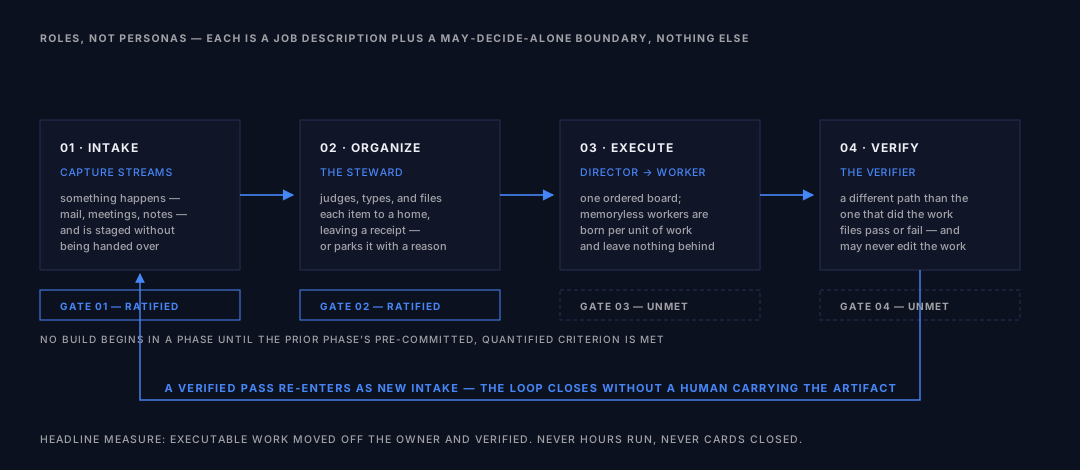
The loop closing is the design’s whole ambition. A pipeline hands its output to a person; a loop feeds itself. Everything else in the architecture exists to make that safe enough to leave running.
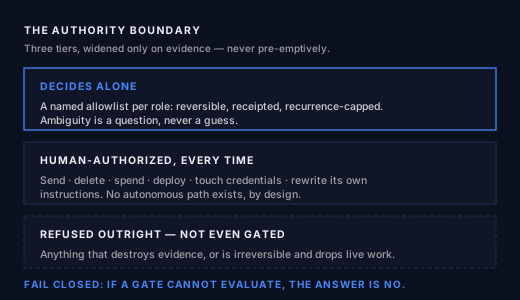
Roles carry authority, not personality. Each one publishes what it may decide alone and what it may never do without me, and the second list is the load- bearing half: send anything, delete, spend, deploy, touch credentials, or rewrite its own instructions. There’s no autonomous path through any of those, and the scope starts narrow — a role gets a capability when a real task needs it, never in advance because it might.
Method
The method is the case study. Three rules did most of the work.
Criteria before the build. Each phase has a done-when written before a line of it exists, quantified, and binary. Intake’s: five consecutive zero-touch items per stream, every stream deliberately broken to prove it alarms within one cycle — and one waiver, dated and recorded: the stream I operate by hand closed early, because a zero-touch counter proves nothing about a surface that can’t fail silently on its operator. Organize’s: consecutive items filed with receipts, zero orphans, holding area drained. They’re ratified by a dated ruling or they’re not met — and the two that aren’t met are published in the same table as the two that are.
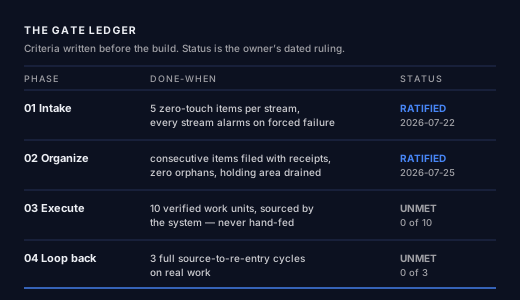
Work, never time. The first version of the trust model graduated a subsystem after seven consecutive green days. That criterion measured nothing: a week can span five tasks or five thousand, and calendar time is not evidence of anything except patience. It was struck and replaced with verified units and event coverage — one clean cycle of each condition that previously failed, and verification passes that scale with volume instead of with the almanac.
Fail closed, and prove it by breaking it. For anything that sends, deletes, spends, or mutates, a gate that cannot evaluate must block. That sounds obvious and is the opposite of most defaults, which fail open when something errors — so the direction has to be an explicit decision and then demonstrated by deliberately forcing the failure. An unproven gate is an open gate. There’s a companion test that keeps gates from becoming furniture: is this gate proving a capability, or excusing an unfinished design? A gate that becomes permanent is a confession.
The laws came from failures, and the failures were all the same shape: something read green while nothing worked.
An overnight run sat wedged for nine hours behind heartbeats still firing from dead processes. A full day passed with zero work moved and every health check green, because the trigger had never been wired — which produced the rule that an idle board with workable items is a failure, in the same class as a service being down.
The clearest one came last. A background service had been restarting every ten seconds for 22.5 hours — 7,689 times, zero alerts, zero progress — because automatic-restart-on-failure without a restart budget isn’t resilience, it’s a silent-failure generator. I’d assumed automated restarts were quietly saving me somewhere, so I checked all thirty-nine background services for evidence of successful self-healing and found none. Not less than expected. None. A single bounded restart counter would have turned 7,689 silent events into one alert, which is why it’s the first capability the remediation role gets — and why the next phase of this build is monitoring, not features.
Measured outcome
Consecutive items, each landing a receipted disposition — routed, deduplicated, or parked with a stated reason — zero orphans. The evidence batch that closed the organize gate.
Every one accounted for in a single unattended pass, with identical before-and-after board state — the execute phase proving its read side.
Verified work units against the execute gate. The write side stays shut until the read side is boring. Published as-is.
What the platform does today, unattended: captures across every live stream — mail, meetings, notes — and gives each item a receipted outcome, filed to a home or parked with a stated reason, both against criteria I wrote before building and ratified after. What it deliberately doesn't claim: an autonomous fleet running my life. The execute phase reads and reasons but does not yet create work, because its gate asks for ten verified units from sources the system found itself, and hand-feeding it would pass the gate while failing the point. The number above is zero and stays published as zero. A platform whose whole thesis is verified work can't make an exception for its own scoreboard.
Appendix — method notes
Design. Four phases — intake, organize, execute, verify — arranged as a loop, so a verified result re-enters as new intake instead of waiting for a human to carry it. Roles are job descriptions, not characters: each states its duties, a two-column may-decide-alone / never-without-me boundary, and its blast radius. Workers are memoryless and born per unit of work; anything worth keeping leaves as a note attributed to the role.
Doctrine. Policy lives in schema-validated config files, never in code — agents propose changes, never apply them, and an invalid edit fails loud onto the last known good. Event-driven is the default, with a 30-minute hard cap on any surviving timer and one test to justify it: is this timer here because no event exists, or because I didn't wire the event?
Failures that wrote the laws. An overnight run wedged for nine hours because a concurrency cap was written to a file the dispatcher never read, while per-item heartbeats kept firing from dead processes — every automated check read green. A full day passed with zero work moved and zero alarms, because the thing meant to trigger the day had never been wired. And a "seven consecutive green days" trust criterion turned out to measure nothing at all: a week can span five tasks or five thousand.
Boundaries. This page is architecture only, on purpose. The underlying stack, hosting, models, and the mechanics of any gate are all deliberately absent — a system whose safety rests on bounded authority shouldn't publish the boundary's implementation. The doctrine transfers; the wiring is nobody's business.